


Introduction
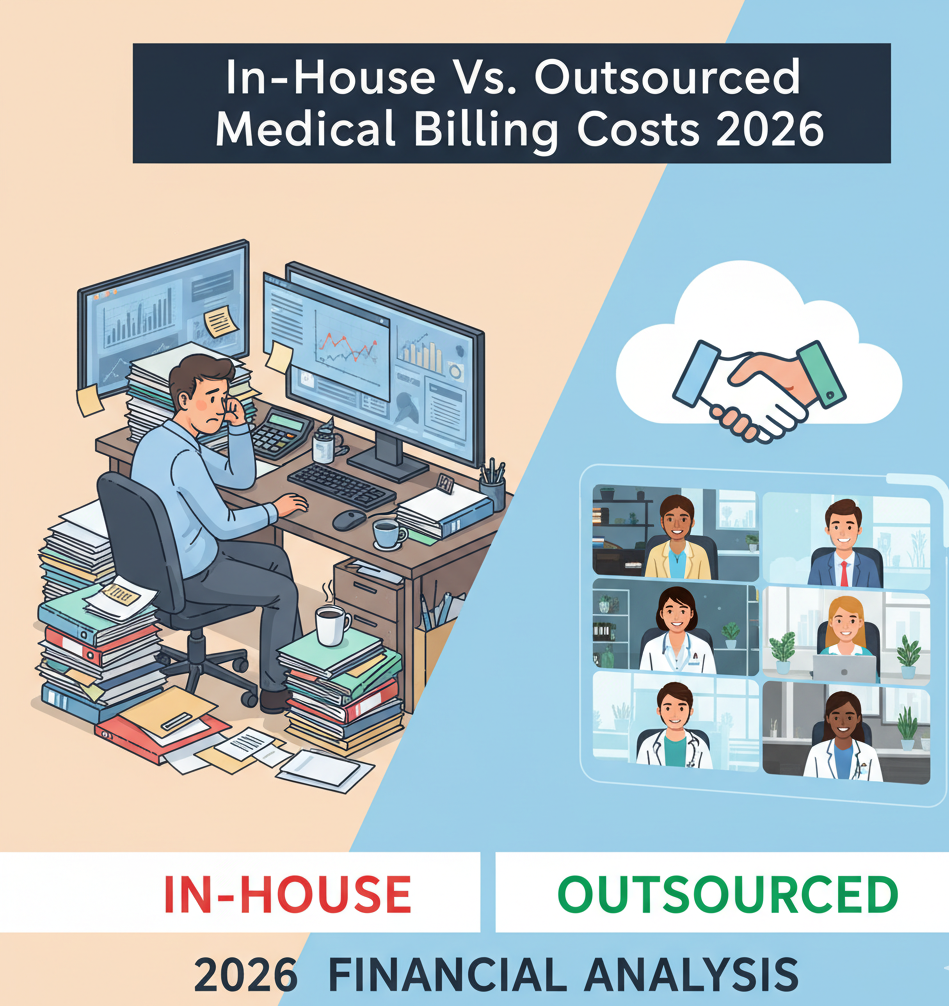
Choosing between in-house and outsourced medical billing is one of the most critical financial decisions healthcare providers face in 2025. With claim denial rates climbing above 15% and administrative costs consuming nearly one-third of healthcare revenue, understanding the true cost difference between managing billing internally versus partnering with specialized providers is essential for practice profitability.
The medical billing landscape has transformed dramatically. Today’s healthcare providers must navigate complex coding requirements, evolving payer policies, and stringent compliance regulations while maintaining healthy cash flow. Whether you run a small independent practice or a multi-specialty clinic, your billing approach directly impacts your bottom line, staff productivity, and ability to focus on patient care.
This comprehensive guide breaks down the actual costs, hidden expenses, and financial outcomes of both billing models. You will discover real data from 2025 showing how practices save between 40% to 60% on operational costs by making informed billing decisions. More importantly, you will learn which approach aligns best with your practice size, specialty, and growth goals.
Understanding Medical Billing Cost Structures
Before comparing specific models, you need to understand what drives medical billing expenses. Both in-house and outsourced approaches involve distinct cost categories that affect your practice differently.
Direct Vs Indirect Billing Expenses
Direct costs are straightforward and appear clearly on your budget. These include staff salaries, software subscriptions, and service fees. A typical medical biller earns between $55,000 and $75,000 annually in 2025, not including benefits that add another 20% to 30% to compensation costs.
Indirect costs are stealthier but equally impactful. Claim denials from coding errors can cost practices $50,000 to $200,000 yearly. Training expenses for keeping staff current with ICD-11 codes and CPT updates run $2,000 to $5,000 per employee biennially. Days in accounts receivable stretching beyond 45 days drain working capital and reduce financial flexibility.
The True Cost Of In-House Medical Billing
Managing billing internally gives you direct control but comes with substantial financial commitments that extend far beyond basic salaries.
Staffing And Payroll Expenses
Building an effective in-house billing team requires certified professionals. For a mid-sized practice processing 1,000 claims monthly, you typically need two to three full-time billers and one coding specialist. Annual payroll alone ranges from $180,000 to $250,000, excluding benefits packages that include health insurance, retirement contributions, and paid time off.
Staff turnover creates additional costs. The healthcare billing industry experiences turnover rates near 40% annually, driven by job burnout and competitive hiring. Each replacement costs approximately 50% to 75% of an annual salary when you factor in recruiting, onboarding, and the productivity loss during transitions.
Technology And Software Investments
Electronic Health Record systems and dedicated billing platforms represent major capital expenditures. Implementation costs for mid-sized practices range from $100,000 to $300,000, with annual licensing fees between $12,000 and $60,000 depending on user count and feature requirements.
Ongoing maintenance, security updates, and HIPAA compliance measures add 15% to 20% to your annual technology budget. Cloud-based solutions reduce upfront costs but still require $3,000 to $8,000 per provider annually.
Training And Compliance Costs
Medical billing regulations evolve constantly. Keeping staff certified and compliant with changing payer requirements costs $5,000 to $15,000 annually per practice. This includes continuing education credits, certification renewals, and attendance at industry conferences.
Compliance failures carry steep penalties. A single HIPAA violation can result in fines from $100 to $50,000 per incident, with annual maximums reaching $1.5 million for repeat violations.
Hidden Operational Costs
Beyond obvious expenses, in-house billing drains resources through decreased collection rates, extended payment cycles, and higher denial rates. Practices report collection rates between 60% and 75% with in-house teams compared to 85% to 95% with specialized providers.
Accounts receivable days averaging 50 to 60 days versus 30 to 40 days with outsourced services represent significant opportunity costs. That delayed revenue could otherwise support practice growth, equipment purchases, or additional provider hiring.
Outsourced Medical Billing Costs Explained
Medical billing services operate on fundamentally different economics, converting fixed overhead into variable costs aligned with your actual collections.
Percentage-Based Pricing Models
Most medical billing companies charge between 4% and 8% of net collections. For a practice generating $1 million in annual revenue, this translates to $40,000 to $80,000 yearly. This model aligns the billing company’s success directly with yours, creating shared incentives for maximizing collections and minimizing denials.
Smaller practices may pay slightly higher percentages between 6% and 10%, while larger organizations with higher claim volumes often negotiate rates between 3% and 5%.
Flat-Fee Service Options
Some providers offer flat monthly fees ranging from $200 to $1,500 depending on claim volume and service scope. This pricing model provides cost predictability but may not scale efficiently as your practice grows.
Setup And Transition Expenses
Initial implementation costs typically range from $5,000 to $15,000, covering data migration, system integration, and staff training on new workflows. Most practices recoup these investments within three to six months through improved collection rates and reduced administrative burden.
What Services Are Included
Comprehensive outsourced billing typically includes charge entry, coding, claim submission, payment posting, denial management, patient billing, and accounts receivable follow-up. Advanced providers also offer revenue cycle management services encompassing credentialing, eligibility verification, and detailed analytics reporting.
Cost Comparison: Side-By-Side Analysis
Examining actual numbers reveals the stark financial differences between billing models for a typical practice earning $1 million annually.
Small Practice Scenario
For practices with annual revenue under $500,000, in-house billing costs approximately 25% to 35% of collections. This includes one full-time biller at $55,000 plus benefits totaling $73,000, software costs of $10,000, and denial write-offs averaging 12% or $60,000. Total expenses reach $143,000 annually.
Outsourced billing at 7% of collections costs $35,000 with minimal denial losses due to expert coding. Net savings exceed $100,000, representing a 70% cost reduction.
Mid-Size Practice Analysis
Practices earning $2 million to $5 million annually need larger in-house teams. Two billers plus overhead total approximately $200,000. Adding software, training, and denial losses pushes total costs near $400,000 or 20% of revenue.
Outsourcing at 5% costs $100,000 to $250,000 with faster reimbursements and fewer denials. Practices typically save $150,000 to $200,000 annually while improving cash flow.
Specialty-Specific Considerations
Complex specialties like cardiology require specialized billing expertise. Cardiology billing services handle intricate procedure codes, pre-authorization requirements, and payer-specific documentation standards that general billers often struggle with, reducing denial rates from 18% to under 5%.
Beyond The Numbers: Qualitative Factors
Financial comparisons tell only part of the story. Operational efficiency, compliance confidence, and staff satisfaction significantly impact long-term practice success.
Collection Rate Performance
Specialized billing companies consistently achieve collection rates between 85% and 98% compared to 65% to 80% for in-house teams. This 10% to 20% improvement directly increases practice revenue without seeing additional patients.
Claim Denial Management
Expert billers reduce denial rates dramatically. While in-house teams typically face 12% to 18% denial rates, specialized providers maintain rates between 2% and 5%. More importantly, they resolve denied claims faster, recovering revenue that in-house staff often write off.
Speed To Payment
Accounts receivable days measure how quickly you collect payment after providing services. Outsourced billing reduces this metric by 30% to 40%, improving cash flow and financial planning. Instead of waiting 50 days for payment, you receive reimbursement in 30 to 35 days.
Compliance And Risk Mitigation
Medical billing companies in Florida and nationwide maintain dedicated compliance teams monitoring regulatory changes, updating coding practices, and ensuring HIPAA adherence. This specialized expertise reduces audit risks and protects against costly violations.
Scalability And Flexibility
As your practice grows, outsourced billing scales effortlessly without hiring additional staff, purchasing more software licenses, or expanding office space. Medical billing services Florida providers absorb volume increases within existing fee structures, supporting practice expansion without proportional cost increases.
How ACP Billing Services Optimizes Healthcare Revenue
ACP Billing Services delivers comprehensive revenue cycle solutions specifically designed for Florida healthcare providers seeking maximum financial performance without administrative burden.
Their expert team provides complete charge capture, precise medical coding, efficient claim submission, and aggressive denial management. Unlike general billing services, they offer specialty-specific expertise through dedicated cardiology billing services and comprehensive revenue cycle management services in Florida covering every aspect of the billing process.
ACP’s technology platform integrates seamlessly with existing EHR systems, providing real-time transparency into claim status, collection metrics, and financial performance. Their proactive approach identifies revenue opportunities and resolves issues before they impact cash flow.
Beyond billing, ACP offers Practice Management Consulting to optimize operational workflows, improve patient satisfaction, and support strategic growth initiatives. This comprehensive approach addresses the full spectrum of practice management challenges.
Conclusion: Choosing Your Billing Path Forward
The cost difference between in-house and outsourced medical billing extends far beyond simple expense comparisons. While in-house operations offer perceived control, they burden practices with substantial fixed costs, compliance risks, and operational challenges that divert focus from patient care.
Outsourced billing converts these fixed expenses into variable costs aligned with actual collections while delivering superior performance through specialized expertise, advanced technology, and dedicated focus on revenue cycle optimization.
For most practices in 2025, outsourcing represents the clear path to improved financial performance, reduced administrative burden, and sustainable growth. The question is not whether to outsource, but rather which partner best serves your specific needs.
ACP Billing Services stands ready to transform your revenue cycle with proven expertise, transparent pricing, and measurable results. Contact their team today to discover how much your practice could save while improving collections and reducing administrative stress.
Related Posts

How To Resolve Most Common Denials In Medical Billing | ACP Billing
Every healthcare provider knows the frustration: you deliver quality care, submit a claim, and then—denied.…

CPT vs ICD Codes: Key Differences Explained
If you’ve ever wondered why your medical bills look like an alphabet soup of numbers…

Top 10 Claim Denials Hurting Your Medical Practice
Every healthcare provider knows the frustration of claim denials. You provide excellent patient care, submit…
Medical Billing Denial Codes: Complete Guide to Reasons & Solutions
Getting claim denials can feel like hitting a brick wall when you’re trying to keep…